
Winning unanimous consent for Exeter College's 20-year masterplan
KOR Communications designed and delivered the stakeholder engagement and public consultation for Exeter College's 20-year, £70 million masterplan for its Hele Road campus in Exeter. Ninety per cent of those giving feedback supported the proposals, and Exeter City Council's planning committee gave the outline application unanimous approval in July 2019.
The project
Exeter College's Hele Road campus sits on the site of a former secondary school in a conservation area. Listed buildings surround it, including almshouses and a church. Student numbers were rising, partly because of demographics and partly because of the college's Outstanding Ofsted rating, so the college needed more and better teaching space. It ruled out moving to an edge-of-city site. Public transport serves the current campus well, and the city centre location benefits both the college and Exeter.
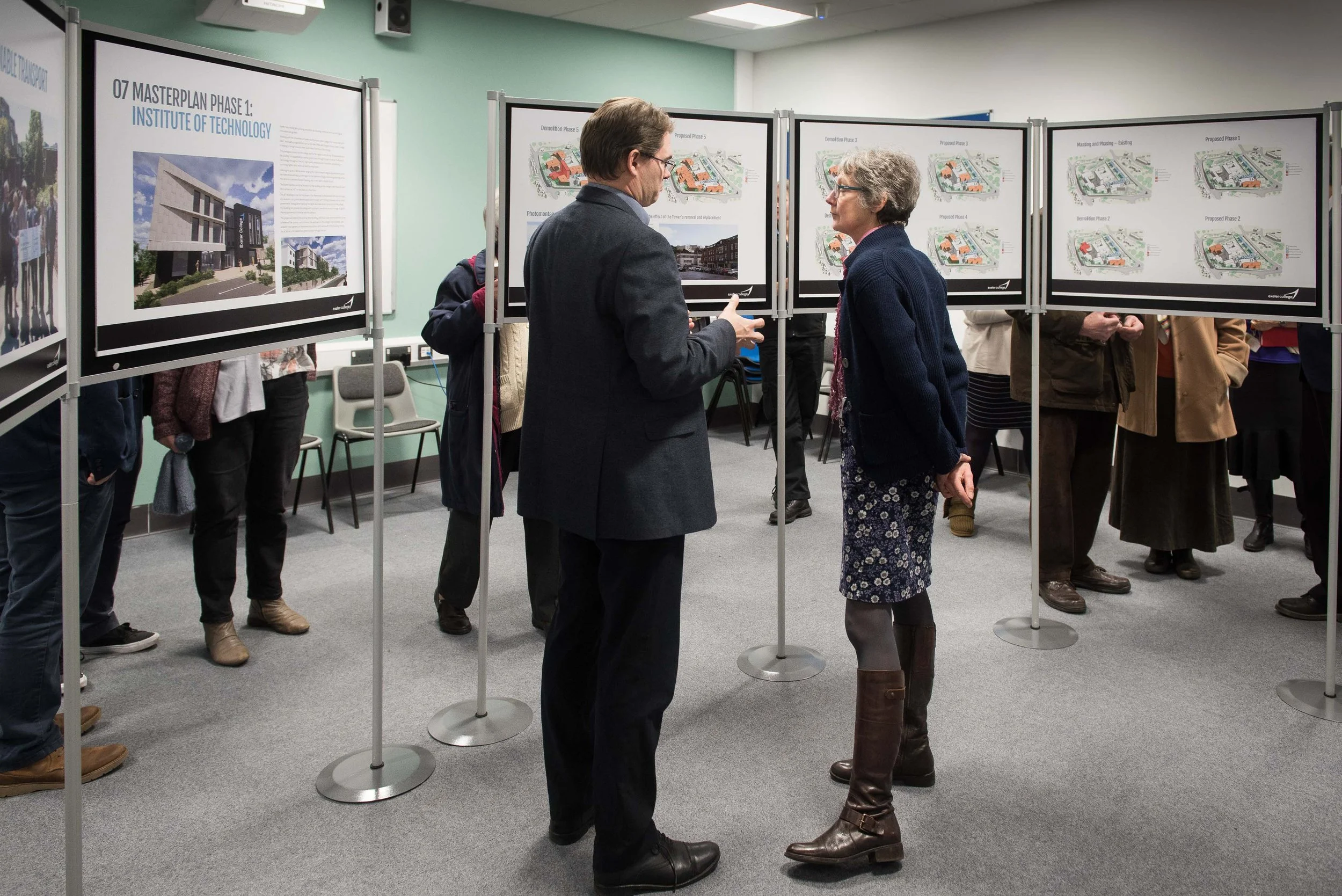
The outline masterplan proposed demolishing the college tower, which is a city landmark but a poor modern teaching environment. A full application for a new Institute of Technology Digital and Data Centre went in alongside it, developed with the Met Office, the University of Exeter and the University of Plymouth. The plans also include the demolition of the Exeter College tower, something of a city landmark but not an effective modern teaching environment.
Exeter College appointed KOR to design and deliver the stakeholder engagement and public consultation for the masterplan before the outline application went to Exeter City Council.
Our approach
Exeter College's relationships reach well beyond the city, so we began with in-depth stakeholder mapping and an impact-influence assessment to shape the engagement strategy. That led to one-to-one meetings with city councillors and invitations to the city's MP, county councillors, secondary headteachers, business leaders, the St David's Neighbourhood Partnership, Exeter Civic Society and Exeter Cycling Campaign. In a densely populated area, invitations also went to more than 600 homes and businesses within half a kilometre of the campus.
A one-day public exhibition was supported by a project website we built in-house, with paper and online feedback forms. Because the college draws students from across the county, a front-page story in the local weekly newspaper and the college's social channels carried the consultation well beyond the immediate neighbourhood.
The outcome
The media campaign saw widespread coverage in print and online and our press release was seen by tens of thousands of people.
Around 50 people visited the in-person exhibition and more than 1,400 viewed the project website in the two-week consultation timeframe.
The response from the public was overwhelmingly positive, with 90% of those offering feedback saying they were supportive or very supportive of the proposals. This was broken down into 74% very supportive, and 16% supportive.
The planning application also saw supportive comments from organisations including the Exeter Civic Society. Exeter City Council's planning committee voted to give unanimous approval to the application, and work got under way in good time, with the new Institute of Technology opening in July 2021.
-
It is not unknown for planning applications to be refused by councillors in Exeter citing a lack of pre-application public engagement.
And the college's application was not just for one building, it was for the regeneration of the majority of its estate in Hele Road.
As such, it was asking the council for outline consent for the next 15 to 20 years. This required a high level of engagement and other support. The end result gave the college the confidence to plan ahead and ensure funding was in place for its requirements.
-
The tower, being visible from viewpoints across the city, provokes mixed emotions. One consultee said "I think the tower building is one of the iconic buildings of the city. A similar tower building would suit the plans better and retain the Exeter skyline."
But another said "Although part of 'scenery' for 55 years it's not aesthetically great. I would not miss it."
The tower is included in the fifth and final phase of the regeneration. While unloved by many, the teaching space it provides will need to be available elsewhere on the campus before it no longer towers above the skyline.
-
What has to be considered is whether you think a neighbour could reasonably say they would be meaningfully affected by any proposed changes.
That largely takes in the closest neighbours, of course, but how far do you go? That depends on factors such as the roads and traffic patterns, and whether the site is particularly visible and whether the proposals change this.
The college tower is visible from hilltops miles outside the city. But if it were no longer there, would that meaningfully affect someone who lived four miles away? Not really. But if their child were soon to start their A-levels or an apprenticeship, the college's plans might well affect them. That's why the media and social media campaign was targeted at a much wider area.